A Brand Character Is a Recall Machine
Published on 17 September, 2026 | Author: Agnes Marggs | 4 min read
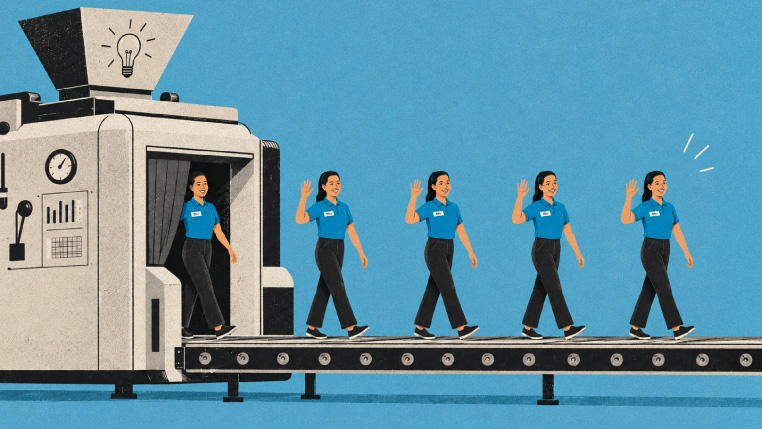
A plumber stands at a counter with paperwork he needs shredded and quotes he needs printed. A portal opens beside him, and a woman in a blue polo shirt and black pants steps through to handle it. That is one of the first 30-second spots for Blu, and the choice worth noticing is that the help arrives as a person rather than as an app.
The UPS Store unveiled Blu on August 31 as its first-ever brand character, launching an integrated multiyear national campaign that spans broadcast television, digital, social and print. Michelle Van Slyke, senior vice president of marketing and sales, framed the character as standing for the knowledgeable support and dedicated care that customers get across more than 5,500 US locations. Blu appears alongside professional football player Aidan Hutchinson across the Paramount ecosystem, with the wider campaign rolling out over the coming months.
What happened, in campaign terms, is narrower and more interesting than a mascot debut. A franchisor whose locations are largely owned and operated by independent franchisees gave itself one recognizable asset that every one of those locations can stand behind. The spots are built around specific jobs rather than sentiment: printing and shredding in one, a business mailbox for the owner of a custom sneaker brand in another.
The move sits inside a broader revival. Insurance has spent two decades proving that a recurring human character outperforms a product claim, and Blue Bunny reintroduced its own mascot, also named Blu, back in April. Characters are cheap to remember and expensive to replace, which is exactly why brands keep returning to them.
Name the mechanism plainly. A character is a recall device that fires at a moment of need, not a likability play. The next time a small business owner has to get something notarized, shipped or printed by Friday, the brand wants to be the one that surfaces before the search does. For a network of independent operators, the same asset does a second job, because it hands 5,500 locations a single story instead of 5,500 local interpretations of one.
The mechanism alone does not explain the timing, though. Recall is worthless if the thing being recalled is a commodity, and parent company United Parcel Service is in the middle of deciding it will not be one. On the Q2 earnings call, CEO Carol Tomé described a focus on capturing premium volume from customers including small and medium business, health care and B2B, after the company cut Amazon delivery volume and restructured its network. A brand character is what you build when you want higher-value relationships and need clearer communication to earn them.
That is the part worth sitting with if you sell through resellers, franchisees, channel partners or a distributed field team. Every one of those models has the same failure mode, which is that the brand dissolves at the edges. Head office ships a positioning deck, the partnerships whatever fits the local pitch, and the buyer ends up with an impression assembled from fragments. A distinctive asset survives that journey in a way that a message hierarchy never does.
Concretely, distinctiveness is not a logo refresh or a new palette. It is a repeatable element that shows up identically in a partner’s deck, a regional email, a trade booth and a sales follow-up, and that a partner can use without waiting on a brand review. It must be ownable, portable and dull enough to repeat for years.
Run the test on your own company. Name the one asset a buyer could describe back to you without your logo in front of them and be honest about the answer. For most B2B brands it is a color, a font, and a founder’s face on LinkedIn, which is a set of things that disappear the moment that founder stops posting.
The plumber in that spot will not remember a service list. He will remember that someone in a blue polo came through a door and dealt with it, which is the whole point.