One Joke, Two Years, One Newly Public Company
Published on 24 September, 2026 | Author: Agnes Marggs | 4 min read
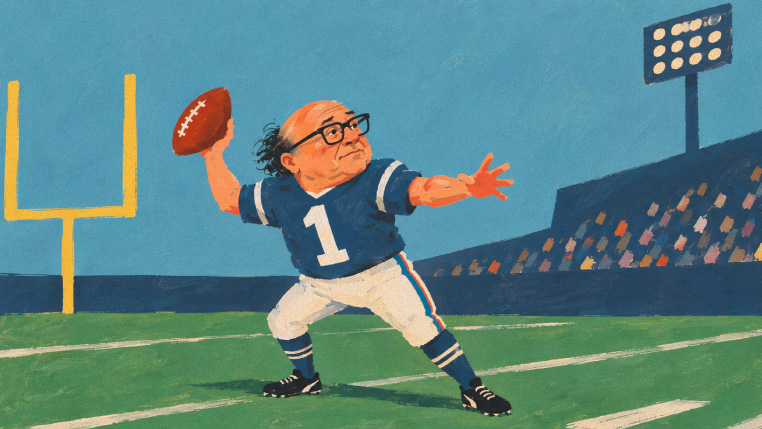
Danny DeVito has a jacked arm now, and it is the NFL’s fault, or Jersey Mike’s fault, depending on which year of the joke you are watching. In the brand’s newest spot, DeVito’s arm swells from years of lifting stacked subs until he is drafted as a quarterback, sidelining his real rival, actual Super Bowl-winning quarterback Eli Manning, who spent last year’s campaign trying to steal DeVito’s spokesperson job. Now DeVito has stolen his instead.
Jersey Mike’s unveiled the film, “Stacked and Jacked: The Danny DeVito Story,” on September 15 as the centerpiece of a platform it is calling “Game Day Mike’s Way,” created again with agency of record Highdive. The chain calls it the most integrated Jersey Mike’s campaign to date, running across broadcast, digital and social as the second year of its NFL sponsorship, which made it the league’s official sub sandwich partner in March 2025.
The premise is a sequel with a twist rather than a fresh idea. Last year, Manning joined as a new spokesperson and DeVito played the aggrieved incumbent. This year, DeVito takes the field and Manning watches from the sidelines, the joke’s tension flipped rather than replaced.
What actually happened here is smaller and more useful than a celebrity stunt. Jersey Mike’s took a bit that worked once and built a second act instead of a new campaign, which is the harder creative decision. Most brands treat a successful spot as a one-off to be topped next cycle. Jersey Mike’s treated it as a character relationship that could develop, the same instinct a sitcom uses to justify a second season instead of a new show.
Name the mechanism directly. A running joke that develops instead of repeating is a compounding asset, not a disposable one. Each new chapter is cheaper to make sense of than the last, because the audience already knows DeVito and Manning are rivals. That prior knowledge is doing narrative work for free, the same work a brand otherwise pays a first act to do every single time.
The mechanism alone does not explain why now, though. This campaign lands four months after Jersey Mike’s debuted on the New York Stock Exchange in July, and on the chain’s first earnings call as a public company, CEO Charlie Morrison said digital marketing spend had grown from less than 1% to over 20% of total marketing budget in the first half of the year, aimed squarely at reaching Gen Z. A campaign built to run across social as much as broadcast is not incidental timing. It is the spending shift, executed.
That is the part worth sitting with if you report to a board now, or answer to new public-market scrutiny of every marketing dollar. Morrison did not describe the digital pivot as a bet. He described it as a gap the company had simply never addressed before 2026, and one that showed positive results once addressed. A newly public company under earnings-call pressure chose to keep funding a comedy bit rather than replace it with something that read as more serious, because the bit was already proving efficient.
What does distinctiveness look like here, concretely? It is not the celebrity pairing itself. Plenty of brands hire two famous men and film them bickering. It is the decision to let the joke remember its own history, so a viewer who saw last year’s spot gets a payoff this year that a first-time viewer does not, without either viewer being confused.
Run the test on your own company. Find the one piece of content your buyers actually remember, not the one leadership was proudest of, and ask whether anyone gave it a sequel or simply moved on to the next campaign brief. Most B2B marketing treats every quarter as a clean slate. Jersey Mike’s just proved a callback is cheaper than a reintroduction.
Eli Manning is still on the sidelines. Next year, if the joke holds, he gets his job back, and Jersey Mike’s gets a third act it did not have to invent from nothing.
Recommended Post