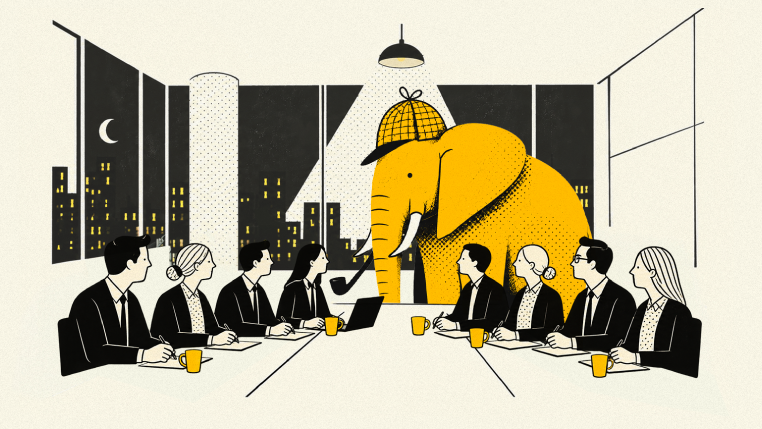
The Elephant Files: a marketer’s playbook of B2B’s open secrets.
Published on 29 October, 2026 | Author: Agnes Marggs | 6 min read
Every industry has its elephant in the room: the thing everyone sees, and no one says. B2B marketing has a whole herd: strategies that stopped working, metrics that stopped meaning what they report, budget math held together by agreement rather than arithmetic. We trade these truths over coffee, then leave them out of the deck.
The Elephant Files is where we say them out loud. No fluff, no vendor spin, just the honest version of the conversation marketers are already having off the record. Each file names one elephant and asks what it costs you. We’re starting with money, the pinch everyone feels.
Because here’s a scene playing out everywhere right now. It’s 4:47 pm on a Thursday, and the quarterly budget review is almost over. The CMO scrolls back through the deck one more time. AI adoption: up. Content output: tripled. Headcount: leaner than last year. Every efficiency metric is glowing.
Then she reaches the last slide. Total marketing spend hasn’t dropped. It’s gone up.
She’s not alone (and she’s not bad at math). This is the contradiction sitting in budget rooms across companies, and almost nobody says it out loud. If AI makes everything cheaper, where is the money going?
That’s Elephant 1: the cost conundrum. It has three parts: prices that aren’t real, usage that won’t stop growing, and a human premium nobody budgeted for. Let’s name it properly.
The story we all agreed on.
First, let’s be fair to the consensus. AI really does automate the grunt work. It drafts in seconds what used to take days, scales campaigns without scaling teams and personalizes at a volume no human department could touch. None of that is hype. Your team is probably living it right now.
The industry settled on a comfortable equation: AI equals efficiency, and efficiency equals savings. We repeated it in board decks, vendor pitches and LinkedIn posts until it sounded like a law of nature.
But efficiency was never the question. Cost is. And cost has three open secrets the industry would rather not examine. Time to open the file.
Secret 1: Nobody’s paying full price.
Why is AI this cheap?
The honest answer: it isn’t. The price is sponsored. Reporting on OpenAI’s internal financial projections shows the company expects to lose 14 billion dollars in 2026, roughly triple the year before. The most-used AI tools in your stack are priced below what they cost to run, funded by investors betting on market share today and profit someday. Your AI line item isn’t a cost. It’s somebody else’s growth strategy.
And the infrastructure beneath those prices is straining to keep up. Sightline Climate research finds that 30 to 50 percent of the data center capacity slated to come online in 2026 could be delayed, and some may never be built. The bottleneck is physical: Wood Mackenzie’s industry survey puts power transformer deliveries at 128 weeks on average, and the largest units take closer to three years. Demand is exploding at the exact moment supply is jammed. You don’t need an economics degree to finish that sentence.
Here’s the uncomfortable math. Every AI workflow you’ve built assumes today’s pricing holds. What happens to your budget when someone finally sends the real bill?
Secret 2: Cheaper per task, costlier per month.
The price of AI keeps falling, and your AI spend keeps rising. How are both true?
The culprit is volume. Stanford’s AI Index tracked the cost of a GPT-3.5-level query, falling more than 280-fold in under two years. But usage exploded past it. One “simple” task now fires a chain of model calls. Every tool in your stack added an AI feature, with an AI price tag. Falling unit costs and rising total bills aren’t a contradiction. They’re what happens when usage outruns efficiency.
And efficiency isn’t effectiveness. IBM’s Institute for Business Value found only 25% of AI initiatives delivered their expected ROI. McKinsey counts 88% of organizations using AI, with nearly two-thirds stuck before scale. You’re paying subsidized prices, on exploding volume, for returns that mostly haven’t arrived. Now add the part nobody priced in: the humans.
Secret 3: Sounding human is the new premium.
The AI-optimized cost cut made sense on paper. Automate the content, run a lean team, bank the difference. But everyone ran the same play, with the same tools, at the same time. And everything started sounding the same.
Forrester’s 2026 predictions put it plainly: human expertise will rival generative AI in appeal as buyers seek deeper validation. Translation: in a flood of machine-made sameness, a real point of view is what stands out, and what converts.
Klarna learned this with the whole internet watching. After boasting its AI assistant did the work of 700 agents, CEO Sebastian Siemiatkowski said in an interview that the result was “lower quality,” and the company started hiring humans again. The savings were real. So was the cost.
That’s the third secret. Distinct, human, credible work didn’t get cheaper in the AI era. It got scarce. And scarce things get expensive.
One wallet, two bills.
This is how the three secrets show up on a Tuesday. You bought AI to shrink the content budget. Output tripled, but sameness tripled with it. You brought seasoned professionals back in to sound authentic and form deeper connections with consumers. But the quiet part: you’re now paying two bills at once. One for efficiency, one for effectiveness.
That second bill lands on a budget with no room in it. Gartner’s 2026 CMO Spend Survey puts marketing at 7.8% of company revenue, essentially flat. AI already eats 15.3% of that. And 56% of CMOs say the budget can’t deliver the 2026 strategy as planned.
Remedy for real-world marketers.
Naming an elephant doesn’t move it. Here’s what sharp teams are doing this quarter.
The winners of 2026 won’t be the teams that spent least on AI. They’ll be the ones who knew exactly what they were paying for.
Case file, open.
Back to that Thursday budget review. The CMO closes her laptop, and the deck wasn’t wrong. It was incomplete.
Because AI didn’t make marketing cheaper. It changed what expensive looks like. The question for your next budget review isn’t how much AI saved you. It’s what you’re actually paying for.
Elephant 1, named. There are more in the room. Stay tuned.