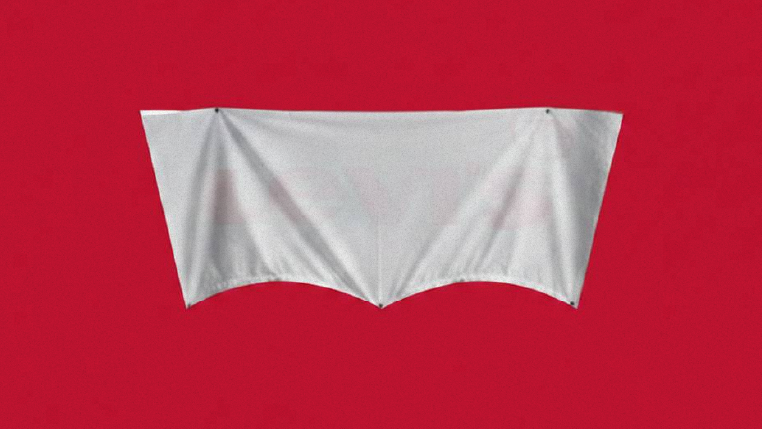
FIFA taped over the logos. The logos won anyway.
Published on 8 July, 2026 | Author: Agnes Marggs | 3 min read
Outside Levi’s Stadium in Santa Clara, a white tarp now covers one of the most recognizable logos in American retail. FIFA ordered the cover-up as part of its clean zone rules for the 2026 World Cup, which ban non-sponsor branding from every official venue. The tarp did its job in exactly one sense: everyone is talking about what’s underneath.
The policy itself is straightforward. Companies pay up to $200 million to become official FIFA partners, and FIFA protects that exclusivity by scrubbing rival brands from stadiums, broadcasts, and even press boxes. With $1.8 billion in marketing rights revenue on the line, 14 of the 16 host stadiums were temporarily renamed, and crews at Gillette Stadium applied roughly 65,000 strips of tape to hide the brand printed on every seat.
Then the plan met the internet. Levi’s posted a video welcoming fans to “the beautiful [redacted] stadium,” swapped its social profile photos for the shrouded logo, and watched a single TikTok pull in 9 million views. The company liked the accidental rebrand so much that it rolled the covered-logo design into stores across seven countries.
Levi’s wasn’t alone, either. Heinz bottles were taped over in World Cup press areas, and the brand leaned into the joke on its own channels. Germany’s Jamal Musiala was filmed covering the Beats logo on his headphones before a match, a clip that went viral with a generous push from Beats itself, while Lumen’s chief marketing officer filmed the de-branding of Lumen Field and published the whole process as content.
Four banned brands ran what amounted to the same campaign without coordinating a thing. There’s a name for part of this: the Streisand effect, where the act of suppressing something makes it impossible to ignore. Tell 54 million viewers they can’t see a logo, and you’ve guaranteed they’ll go looking for it.
But suppression alone doesn’t explain the win. This worked because these brands spent decades building assets so distinctive that a silhouette under a tarp still reads as Levi’s, and a taped-over bottle in a press box still reads as Heinz. The recognition never lived on the stadium wall to begin with—it lives in people’s heads.
That’s the part worth sitting with if you market something less glamorous than denim or ketchup. B2B has spent a decade optimizing for capture: the keyword, the form fill, the retargeting pixel. Brand investment kept losing the budget argument because its returns rarely show up in a quarterly dashboard, and yet a tarp in Santa Clara just demonstrated what those returns actually look like.
Distinctiveness in B2B doesn’t require an iconic logo. It can be a voice buyers recognize before they see the byline, a research report the industry waits for by name, or a point of view competitors can’t credibly copy. What it can’t be is another blue-gradient website explaining that your platform drives efficiency at scale, because nothing about that survives a tarp.
So run the test on your own company. If someone covered your logo tomorrow, would anyone notice what was missing? For most B2B brands the honest answer is no, and that isn’t a creativity problem or even a budget problem. It’s the bill arriving for years of choosing capture over memory.
FIFA needed a tarp, a rulebook, and 65,000 strips of tape, and it still couldn’t make Levi’s disappear. Your competitors won’t need any of that.