McDonald’s Wants Ad Dollars From a Sliver of Itself
Published on 1 October, 2026 | Author: Agnes Marggs | 4 min read
Start with a number McDonald’s put in its own press release: approximately 95% of its restaurants worldwide are owned and operated by independent franchisees, not the company itself. Now hold that next to the number it announced four days later at its investor day. The pilot for its new advertising business is running in exactly 450 restaurants, all of them company-owned.
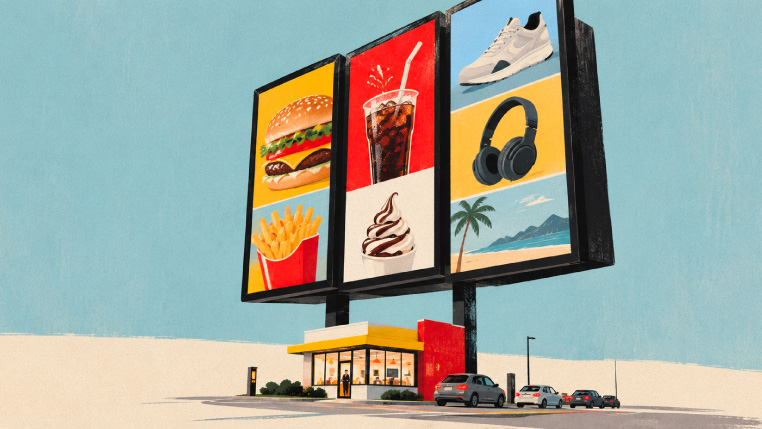
At its 2026 Investor Day on September 23, McDonald’s laid out a new growth strategy and, inside it, a new ad business. Executives said during the presentation that the company is building the McDonald’s Media Network, selling ad space from other brands across its app, kiosks, menu boards and drive-thru screens, with an ambition to turn it into a billion-dollar business over time. Global CMO Morgan Flatley told investors commerce media is one of advertising’s fastest-growing categories, expected to top $100 billion in the US by 2028, and that a pilot moved into market testing across those 450 restaurants last month.
To understand why the restaurant count matters, start with what McDonald’s actually owns. Its own investor day release states the company runs on a franchise model at nearly universal scale, with company-owned locations forming a thin sliver of its roughly 46,000 restaurants worldwide. The 450-restaurant pilot sits entirely inside that sliver. McDonald’s is building a billion-dollar ambition on the part of its business it has full authority over, while the part that actually reaches most customers, franchisee-run restaurants, has not been asked to carry a single ad yet.
The under-noticed detail is what that silence implies. Every other major commerce media platform, Amazon, Walmart, Kroger, was built on inventory the company already fully controlled. McDonald’s does not have that. Most of its screens belong to franchisees who pay for their own equipment, their own leases and their own customer relationships. Executives framed the network as revenue that costs little and adds no operational complexity. That framing describes the company-owned pilot. It says nothing yet about what a franchisee gets, or gives up, when a stranger’s ad starts running on a menu board they paid to install.
Read as a sequence, the investor day itself hints at the tension. The same presentation announced $8.5 billion in franchisee support through 2036, an unusually large commitment tied to modernization and technology. A media network scaling across the same screens franchisees are being asked to upgrade is not a footnote to that investment. It is the next thing riding on top of it, and the terms have not been set.
This is not an isolated move. Retail media has become the default answer to slowing traffic across retail and restaurants alike, and McDonald’s stock had fallen roughly 18% over the twelve months heading into the announcement. A high-margin ad business is an attractive lever to pull when comparable sales growth gets harder to find elsewhere.
What does this mean for a marketer with no restaurant chain and no ad inventory of their own? Watch how the franchise question gets resolved, because it is a preview of a fight every platform business eventually has: who gets paid when a third party monetizes space someone else built and maintains.
There is a second signal worth reading in the timing. McDonald’s chose to unveil the network at an investor presentation, not a franchisee convention. The audience for this announcement was shareholders, not the owner-operators whose restaurants the network will eventually need.
One caution before writing this off as exploitation. Franchise agreements already govern signage, menu boards and screens in detail, and McDonald’s has run co-marketing programs with franchisees for decades. This may simply be an early pilot that expands with revenue-sharing terms nobody has announced yet.
The practical takeaway: before your own company signs onto someone else’s retail media network, ask who actually owns the screen your ad will run on, and what happens to that relationship when the platform outgrows the pilot.
McDonald’s found $1 billion sitting inside 5% of its own restaurants. The harder number is what the other 95% will cost to bring along.
Recommended Post