How Creative Is Overpowering Your Data In B2B Marketing
Published on 30 September, 2026 | Author: Cory Treffiletti | 5 min read
Cory Treffiletti is a data-driven storyteller with a career built on marketing and a passion for thinking differently. As Chief Marketing & Digital Officer at Rembrand, he drives growth for the company’s precision video augmentation technology powering in-content advertising, and its AI-driven social creative intelligence powering social content ads. His career spans senior marketing leadership and entrepreneurship, including SVP of Marketing for fintech company FIS, and CMO roles at Voicea (an AI platform acquired by Cisco) and BlueKai (a data platform acquired by Oracle), plus earlier work as a consultant and agency executive leading successful exits to Omnicom and Carat. Cory is also the author of “Internet Ad Pioneers” and a weekly contributor to MediaPost.
Much of my career was spent telling the story that data is the most important element of any marketer’s toolbox, especially in B2B, where I practice my craft. I think I did a great job, because the whole industry went in that direction. Through BlueKai, Oracle Data Cloud, and my time at agencies like Carat, Freestyle Interactive, and iTraffic, data became foundational. Now it’s table stakes, so commoditized that everyone has it. That opens up a new possibility: with data now providing a level playing field, creativity is the new targeting.
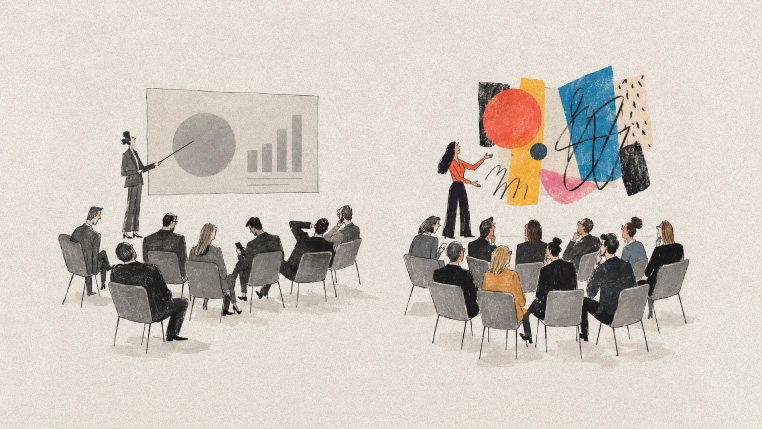
Creative can overpower data.
Great data cannot make up for bad creative, but great creative can overpower poor data. The more creative you have, the more likely you are to unlock audience segments that would have ignored you otherwise. The sharpest audience definition does nothing if what you put in front of it is forgettable. Marry great creative with the right audience, and the results can be incredible.
That’s not an argument against data; it’s narrower than “creative beats data.” Data can drive creative, and creative can deliver performance data alone never could. Too many marketers still treat these as separate camps, when the real unlock is connecting them.
The data advantage has disappeared.
When I was building the case for data, having it was a genuine advantage. Now everyone has roughly the same data. B2B underwent its own gold rush, driven by intent signals, ABM platforms, and account scoring. Two competitors target the same account list with the same intent data, and the only difference is a stock photo and a headline about “transformation,” versus something a person would stop and read. That’s real creative.
This isn’t just my word. Nielsen studied nearly 500 campaigns in 2017 and found creative drove 47% of sales lift, more than reach, brand, or targeting. NCSolutions followed up in 2023 across roughly 450 campaigns and found creative still drove 49% lift, versus 11% for targeting. Those are CPG studies, so I wouldn’t hang the whole B2B case on them, but they’re the closest proof this isn’t just a hunch. Every B2B buyer is just a consumer in a button-up shirt, and consumers like great storytelling.
Most B2B marketers point to the banner or the LinkedIn carousel as their tools of choice, but that’s just one part. Creative is the offer, the narrative arc, the analogy a rep carries into a room, the point of view a company stakes out publicly. It’s the visual, the tone, the feel, the coloring. If you have the right tools, you can produce a lot of great creative for a fraction of what it used to cost, and social content is the best signal for building it: likes, views, and engagement tell you what already works, so build that into what comes next.
Built for the B2B buying committee.
B2B buying is done by committee, and everyone on it wants something different. Strong creative at real volume lets an audience self-select, delivering a different, fresh message to each member: one story for the economic buyer, another for the technical evaluator. Each person gets their own door into the same building.
Production is no longer the hard part. What I look for in my own creative is an actual point of view and a signal that customers like it, which is where social creative comes in. You don’t put your entire budget behind one hero piece and run it everywhere. You build a real content strategy and turn it into a hundred ads instead of one, because more variation means more chances to find what lands. The system is the differentiator, not the individual asset.
That’s the same shift I used to describe as data in, value creation, data out. The model still holds, but value creation used to live in defining segments precisely. Now it lives in how well you match creative to those segments, and how much fresh creative feeds the system.
The lever a marketer works with keeps changing. It was data long enough that I spent a career arguing for it; now it’s creative, and the discipline of building and matching it at real volume. The job isn’t picking a side. It’s building for what the audience wants while meeting your goals for budget and performance, and that makes for great B2B marketing in the same way it works in B2C.
Editorial disclaimer
The views, opinions and perspectives expressed in this article are solely those of the contributor in their individual capacity. They do not represent, reflect or constitute the views of the contributor's employer, any affiliated organisation, or any client or partner thereof.
The B2B Collective and Digitalzone do not endorse any specific product, service or organisation mentioned. The content is intended for informational and editorial purposes only.