Cracker Barrel undid the logo, not the damage
Published on 7 August, 2026 | Author: Agnes Marggs | 4 min read
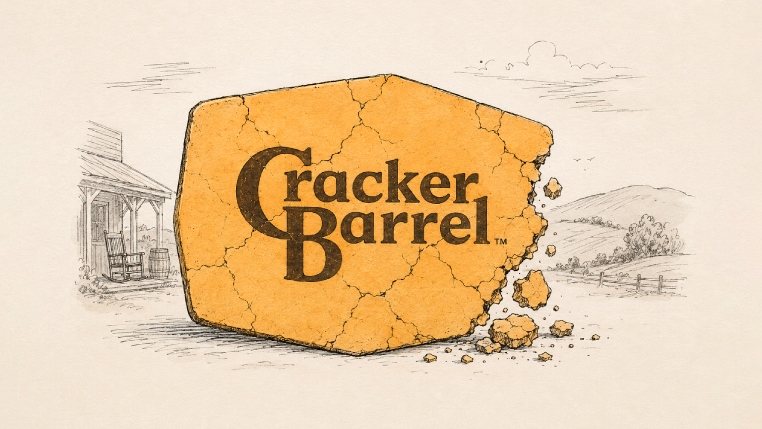
Uncle Herschel is back on the sign, leaning on his barrel where he has been since 1977. Cracker Barrel put him there again last August, days after a modernized logo went up and the internet took it apart. The reversal was fast, public and complete. Then came a year of everything the logo had been covering for, and on August 10 the executive who approved the rebrand hands the company to somebody else.
The last week of July is where the real story sits. Cracker Barrel sold 26 restaurant properties, exited Maple Street Biscuit Company, and raised its fiscal 2026 profitability outlook. One week later it announced that chief executive Julie Masino would step down and that David Deno, who previously ran Bloomin’ Brands, would replace her. Divest, re-forecast, then change the driver. That order tells you more than any logo ever did.
Markets have been generous about it. Shares are up roughly 110% year to date and closed Monday at $52.43, carrying a market cap around $1.2 billion. Writing in Forbes on August 2, Jim Osman argued that the recovery hasn’t resolved the underlying issue, which is that the company committed substantial capital to a transformation without first proving customers wanted it. What’s left, he says, is a credibility discount.
The warning existed. Sardar Biglari of Biglari Holdings, one of the company’s largest shareholders, had been telling the board since 2024 not to spend hundreds of millions on cosmetic change while guest traffic declined and loyalty faded. That critique was on the record before the new logo was. It described a plan, not a mark.
Almost nobody wrote it that way. The comparisons everyone reached for were Gap, which abandoned its Helvetica logo after six days in 2010, and Tropicana, whose 2009 packaging refresh reportedly cost more than $30 million in sales before PepsiCo reverted inside two months. On CNBC, Joe Kernen offered the inevitable one: “It’s not quite as bad as New Coke, but close.” Every precedent in that list is a design story with a design fix.
Which is exactly why the year went the way it did. The logo was the cheapest line item in the transformation and the only one that could be undone in a week. Reversing it produced visible contrition at almost no cost, and visible contrition reads as a problem addressed. The capital was already spent but the traffic was still falling. A design decision took the blame for a capital allocation decision, and the capital allocation decision got another twelve months without scrutiny.
That mechanic should worry anyone running B2B marketing, because our version of the visible mistake is everywhere. Rebrands, category redefinitions, new messaging frameworks, the site refresh, the repositioning deck. These are the most legible things a marketing organization produces and the least likely to have been tested against demand before the money moves. They get approved on taste and internal consensus, and they get defended the same way.
The useful question is not whether the new positioning is better. It’s whether anyone outside the building asked for it. A category you invented because the old one felt crowded is not a category buyers shop in. A messaging framework that survived six rounds of internal review has been optimized for the people in the room rather than the ones signing. And when results come in soft, the visible artifact is what gets revised, because revising it is fast and looks like accountability.
So run Cracker Barrel’s sequence against your own last big swing. Did the demand evidence exist before the budget was approved, or did it get assembled afterward to support a decision already made? For most teams the second answer is closer to true and sitting with that is more useful than another round on the logo, because the money is the part you can’t take back.
Cracker Barrel got Uncle Herschel back in under a week. Deno inherits the part that took a year, and a full turnaround will need a simplified plan and disciplined use of shareholder capital. Deno inherits the expensive half.
Recommended Post